WORKPLACE SAFETY
Singapore’s newest workplace safety alliance isn’t chasing another record-low fatality rate — it’s targeting the injuries that quietly put workers out of a job, and the harder question of getting them safely back into one. For employers, that shift exposes a signage gap most risk assessments never accounted for.
A New Alliance Aims at the Injuries That Don’t Make Headlines
On 23 July 2026, at the Singapore WSH Conference, Minister of State for Manpower Dinesh Vasu Dash launched the Alliance for Action on Safety and Health for Employment Longevity (AfA-SHEL), bringing together the Ministry of Manpower, NTUC and the Singapore National Employers Federation. Unlike campaigns built around fatality statistics, AfA-SHEL is aimed at the injuries that sideline workers for weeks rather than the ones that make the news: slips, trips, falls and work-related musculoskeletal disorders. Its mandate covers three fronts — preventing these everyday injuries in the first place, supporting workers’ return to employment after an injury or health episode, and redesigning jobs and workplaces so an ageing, more diverse workforce can keep working safely.
The Numbers Behind the Alliance
MOM’s own figures explain the urgency. In the first half of 2026, slips, trips and falls, together with vehicular and machinery incidents, accounted for 190 of the period’s major injuries — 61% of the total. Type B incidents, the lower-fatality-risk category that covers slips, trips and falls, fell 11% year-on-year, from 198 cases in 1H2025 to 176 in 1H2026, but they remain the single largest contributor to the injury count. On the occupational disease side, musculoskeletal disorders accounted for 142 of the 620 cases logged in the same period, the second most common diagnosis after noise-induced hearing loss. At the Conference launch, the Minister of State framed the problem plainly: addressing slips, trips, falls and musculoskeletal disorders is particularly important as Singapore’s workforce ages.
Where Return-to-Work Programmes Meet a Signage Blind Spot
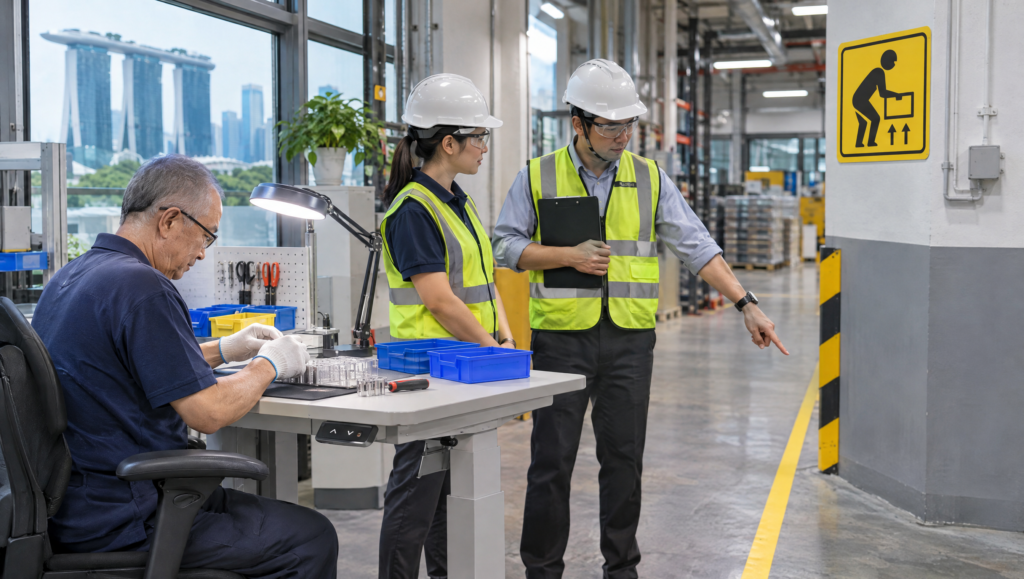
AfA-SHEL’s second and third priorities — supporting workers back into employment after injury, and redesigning jobs to accommodate them — create a problem most risk assessments and signage plans were never built for. A worker returning on light duties, a reduced lifting allowance or a modified workstation is operating under a risk profile different from the one the original signage was designed around. If the floor layout near their station hasn’t been re-marked, if there’s no visible lifting-limit signage at an adapted task, or if a hazard communication board hasn’t been updated to reflect the accommodation, that worker returns into a gap the original risk assessment never flagged — exactly the musculoskeletal and slip, trip and fall exposure AfA-SHEL is trying to reduce.
What Employers Can Do Before the Alliance Issues Guidance
AfA-SHEL is still in its early stages, and formal recommendations will take time to filter down to individual worksites. That’s an opportunity, not an excuse to wait. Employers managing return-to-work cases or redesigning roles for an ageing or recovering workforce can act now: re-walk the floor plan wherever job redesign or modified duties have changed a work area, add or update load and lifting-limit signage at stations now handling reduced capacity, and refresh housekeeping and floor-condition signage in the zones carrying the highest slip, trip and fall exposure. None of this requires waiting for a government framework to formalise — SS 508 and ISO 7010 compliant signage can be updated as soon as a risk assessment changes, which is the whole point of catching these gaps early rather than after an incident.
Whether you’re adapting a workstation for a returning worker or simply tightening up slip, trip and fall controls ahead of whatever AfA-SHEL recommends next, browse SS 508 and ISO 7010 compliant Workplace Safety Signs and barrier and floor-marking solutions at www.safetysigns.sg.
Author: www.safetysigns.sg Team
Date: 23 November 2026