REGULATION UPDATE
Singapore’s outdoor worksites have three weeks left before new heat stress protections become law. The rules cover training, water, emergency cooling and clothing — but not a single line about telling workers, in real time, when the heat has crossed the line.
What Actually Changes on 1 December
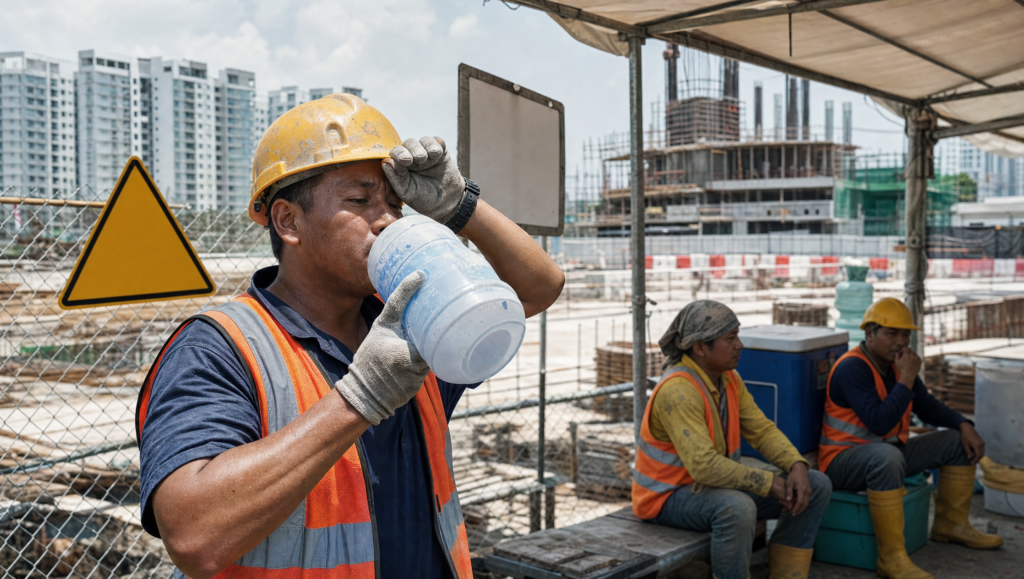
From 1 December 2026, four heat stress measures move from “best practice” to mandatory for every employer with outdoor workers — defined broadly as anyone working primarily without permanent shade, from construction and landscaping crews to event set-up and loading bay teams. Employers must now run heat stress training covering early symptoms, individual risk factors, workplace-specific controls and emergency procedures; keep cool drinking water within a three-to-five-minute walk of the work area; have emergency cooling on standby, meaning enough ice, cold water or spray to actively cool at least one affected worker; and provide loose-fitting, breathable or moisture-wicking clothing. These sit on top of rules already in force: hourly WBGT (Wet Bulb Globe Temperature) checks, on-site WBGT meters for construction sites with contracts of S$5 million or more, shipyards and process plants, and at least seven days of acclimatisation for new or returning outdoor workers.
The WBGT Ladder That Decides Who Works and Who Rests
The new requirements layer onto a WBGT-based ladder MOM has been building out since its 2024 framework. Below 31°C, employers acclimatise new workers, keep water close and confirm an emergency plan is in place. Between 31°C and 33°C, workers should rehydrate at least hourly with 300ml or more, and heavy work should shift to cooler hours where the job allows it. At 32°C and above, workers doing heavy physical work are owed a continuous, paid rest break of at least ten minutes every hour — a break that cannot be banked, split or substituted with a shorter pause. Past 33°C, rest climbs further and vulnerable workers — those over 65, pregnant, newly assigned outdoors, returning from a week or more of leave, or managing a chronic condition — should be redeployed. None of this works if a worker on a scaffold at 1pm has no way of knowing which band the site is currently in.
Why the Signage Line Is Missing From MOM’s Checklist
To be direct about it: MOM’s framework does not mandate a physical sign. Employers can technically comply by briefing workers once and leaving it there. But the practical reality of a hot, noisy, multi-contractor worksite is that WBGT readings change by the hour, rest-break entitlements change with them, and the workers most at risk — new hires, returning staff, older workers — are the ones least likely to have the full briefing fresh in their heads. MOM’s own 1H2026 Workplace Safety and Health report shows why this gap matters: workplace fatalities rose to 21 in the first half of the year, pushing the fatal injury rate to 1.1 per 100,000 workers from 0.97 a year earlier, even as the major injury rate fell to a record low of 14.6 per 100,000 (excluding platform workers), down from 15.8. Singapore is getting measurably better at preventing injuries and no better, yet, at preventing deaths — and heat stress, unlike a fall or a struck-by incident, builds quietly over hours rather than announcing itself in a single moment.
What a Genuinely Ready Site Posts, Not Just Trains
A site that wants to survive an audit — or a coroner’s inquiry — treats the WBGT reading the way it already treats a fire action plan: displayed, updated, and impossible to miss. That means a signboard at the site entrance or muster point showing the current WBGT band and what it means for today’s work; clear markers directing workers to the nearest water point, ideally the same markers used for construction safety signage already required on site; a posted rest-break schedule tied to the WBGT ladder rather than a fixed clock time; and an emergency cooling station clearly flagged the same way a first-aid point is flagged. None of this replaces training. All of it closes the gap between a worker being told the rule in an induction three months ago and a worker knowing, at 1pm on a specific Tuesday, what applies right now.
The Enforcement Risk Employers Are Underrating
MOM has been explicit that failure here is not a paperwork issue. Per MOM’s own FAQs, non-compliance can trigger action under the Workplace Safety and Health Act, including stop-work orders and composition fines, and any heat-related illness must be reported through the standard WSH incident reporting channel — the same channel that feeds the fatality and injury statistics above. With the heat stress framework joining an already tightening season of enforcement — MOM has separately flagged forklift and vehicle-related incidents, haze and PM2.5 exposure, and fall hazards as priority areas this year — outdoor worksites are being asked to prove compliance across more fronts at once, with less room to claim a worker “should have known.”
The three weeks before 1 December are enough time to fix the one part of this rule that training alone can’t cover: making the current heat status, water points and rest entitlements visible to every worker on site, not just the ones who remember the briefing. Browse our full range of SS 508-compliant safety signs at safetysigns.sg.
Author: safetysigns.sg Team
Date: 10 November 2026