WORKPLACE SAFETY
Every safety advisory this year has pointed at construction sites — timber scaffolds, confined spaces, suspended loads. But MOM’s own first-half 2026 numbers show the sector actually pulling ahead on injury rate isn’t construction at all. It’s manufacturing, and metalworking shops are the reason.
The Numbers Nobody’s Talking About
MOM’s 1H2026 Workplace Safety and Health report, released in September, recorded Manufacturing’s annualised fatal and major injury rate at 28.4 per 100,000 workers, up slightly from 27.8 a year earlier. Construction, by contrast, fell to 24.1 per 100,000 — its lowest since 2020. For the first time in this reporting cycle, the sector everyone associates with safety risk in Singapore is no longer the one with the worse rate. The one that is barely gets a mention.
Metalworking Is Doing the Damage
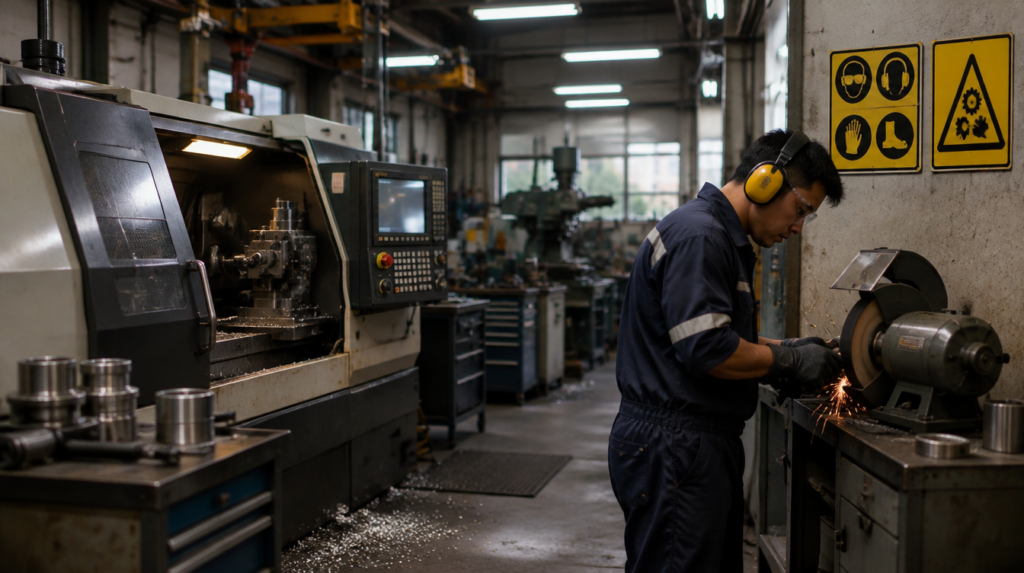
Manufacturing isn’t uniformly worse. Food & Beverages Manufacturing actually improved, with cases falling from 22 to 15. The rate is being pulled up almost entirely by Metalworking, where fatal and major injury cases jumped from 18 to 28 — a 55% increase in a single half-year. That is the kind of swing MOM calls out by name in a sector report, and it is happening in machine shops: lathes, grinders, presses, welding bays, the small and mid-sized fabrication outfits that keep Singapore’s construction and marine sectors supplied with cut, bent and finished metal.
Construction Got the Spotlight, the Factory Floor Got the Blind Spot
Look at where MOM’s enforcement attention has actually gone in 2026: the scaffold fire safety circular, the timber scaffold duration cap, confined-space inspection blitzes, haze and heat stress rules for outdoor workers. Nearly all of it is construction-facing, for good reason — that’s where the fatality count is still highest. But a rate climbing 55% in one sub-sector, in six months, is exactly the kind of signal that gets buried under louder headlines about site deaths. Metalworking shops operate indoors, often in older industrial estates, with less public visibility and far less scrutiny than a construction hoarding on a main road. That’s precisely the condition under which signage gaps go unnoticed the longest.
What a Machine Shop’s Signage Should Actually Cover
SS 508 sets out exactly the categories that matter here, and they’re not the ones a visiting client walking the shop floor usually clocks: mandatory PPE signage at every station — eye protection at grinding and cutting points, hearing protection near presses and compressors, hand protection where stock is manually fed; machine-guarding warning signs at every point of operation, not just a sticker on the machine body when it was first installed years ago; lockout-tagout tags at isolation points for maintenance and changeovers, which inspectors increasingly check for and which a 55% injury jump suggests aren’t being used consistently; and hot-work warning signage around welding and grinding bays where sparks and swarf are a standing hazard. In a shop that’s been running the same way for a decade, the signage installed at setup is often the signage still there today — faded, partially obscured by stock, or simply never updated as machines were added or moved.
The Checklist Before the Next Report
MOM’s 2H2026 figures land early next year, and Metalworking’s trajectory will be one of the numbers worth watching against this half’s 28-case baseline. For employers in fabrication, machining and metalworking, the practical move now is a walk-through: stand at every machine, confirm the PPE sign is legible from where a worker actually stands, check that guarding warnings haven’t been painted over or relocated with the equipment, and verify every isolation point has a current lockout tag. None of that requires an AI tool or a government circular to act on — just an industry that’s stopped assuming the spotlight belongs only on construction sites. Browse our full range of SS 508-compliant workplace safety signs at safetysigns.sg.
Author: safetysigns.sg Team
Date: 16 November 2026