REGULATION UPDATE
Since September, MOM inspectors have walked more than 500 Singapore worksites checking haze preparedness. Forty-eight enforcement actions later, the data points to one overwhelming failure mode — and it isn’t a missing N95 mask.
The Numbers MOM Gave Parliament
In a written parliamentary answer on 4 November, MOM disclosed that since September this year it has conducted more than 500 worksite inspections specifically targeting haze safety measures. As of 20 October, that effort had produced 48 enforcement actions across 46 worksites. The question came from MP Ms Eileen Chong Pei Shan, who asked for a breakdown of lapse types alongside the headline numbers — and MOM’s answer was unusually specific about where employers are actually falling short.
One Lapse Drove 90% of the Enforcement
MOM’s answer named the dominant failure directly: the absence of, or an incomplete, risk assessment identifying haze-related hazards accounted for 90% of all enforcement actions issued. The remaining lapses clustered around the same theme of practical readiness rather than paperwork alone — employers not maintaining a sufficient supply of N95 masks, failing to keep risk assessment records, and, notably, failing to establish a hazard communication system to give workers information on haze-related risks and controls. MOM said it has followed up with every employer concerned to ensure the lapses were rectified, but the pattern across 46 worksites is the real story here: when haze compliance breaks down, it almost always breaks down at the assessment and communication stage, not at the point of having masks in a cupboard.
Why “Hazard Communication System” Is a Signage Problem
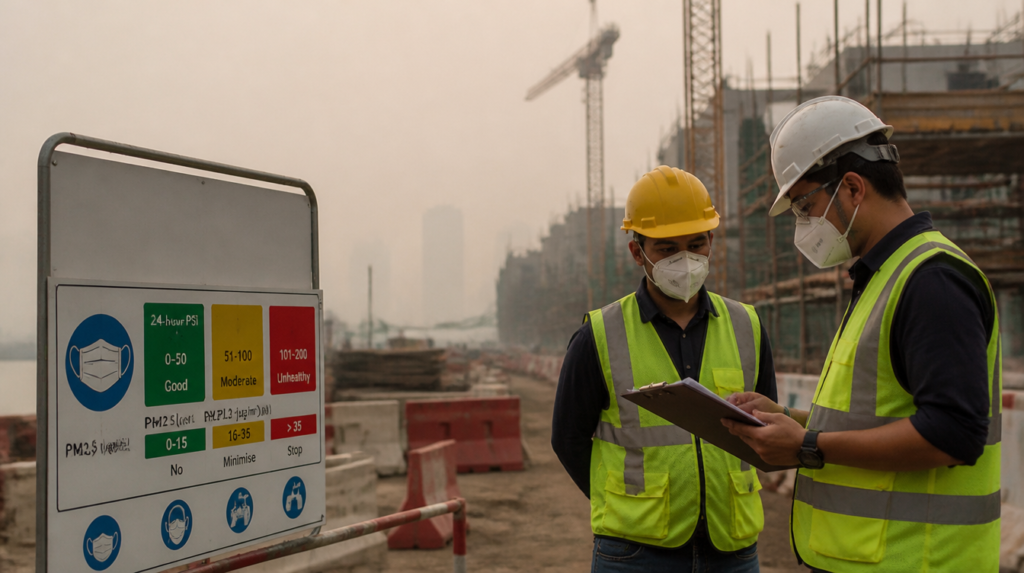
A risk assessment that correctly flags haze as a hazard is only half the job if nobody on the floor can tell what band the site is currently operating under. MOM’s own guidance, which took effect in October, layers hourly PM2.5 readings on top of the next-day PSI forecast specifically because conditions can shift from Band 2 to Band 3 within a single shift. A hazard communication system, in practice, means a worker walking past the site entrance at 1pm can see — without being told verbally, without digging through a folder — what today’s band is, where the nearest water point and mask supply are, and what that means for outdoor work right now. That is precisely the gap a fixed, updatable signboard closes, and precisely the gap MOM’s own enforcement data says 46 worksites failed to close.
What an Inspection-Ready Site Has at the Gate
Reading MOM’s three named failure modes together gives a fairly exact checklist. A documented, haze-specific risk assessment that an inspector can ask for on the spot. A visible, current PM2.5 band indicator at the site entrance or muster point — not a policy that exists only in a supervisor’s head. And a posted reminder of where N95 masks, water points and rest areas are, so the “sufficient supply” MOM wants maintained is also a supply workers can actually find under pressure. None of this is a large capital outlay relative to the S$3,000 first-offence composition fines now in force, or the cost of a stop-work order layered on top of a haze-related incident report.
The Pattern Matches Everything Else MOM Has Flagged This Year
This enforcement sweep isn’t landing in isolation. MOM’s 1H2026 WSH report recorded 21 workplace fatalities and an annualised fatal injury rate of 1.1 per 100,000 workers, up from 0.97 a year earlier, and the Ministry has been explicit all year that the gap it keeps finding is between what’s written in a risk assessment and what’s actually visible to a worker at the point of risk — confined spaces, fall edges, forklift zones, and now haze. Haze enforcement is simply the latest category where MOM’s own numbers show the same failure mode: the paperwork exists somewhere, the communication at the hazard point doesn’t.
Six weeks out from the next likely haze event, 46 worksites now have a documented reason to fix their hazard communication setup — and MOM’s data gives every other employer a preview of exactly what an inspector will ask to see first. Browse our full range of SS 508-compliant haze and hazard communication signage at safetysigns.sg.
Author: safetysigns.sg Team
Date: 13 November 2026