WORKPLACE SAFETY
Singapore’s building sites have never been safer on paper — the construction sector’s fatal and major injury rate just fell to its lowest point since 2020. But strip out the big, well-supervised builds and a different site emerges: the small renovation and addition-and-alteration job, the kind with no tower crane, no dedicated safety officer, and often no sign on the hoarding at all.
A Sector Getting Safer, On Average
MOM’s 1H2026 Workplace Safety and Health report, released in September, shows construction’s annualised fatal and major injury rate falling from 27.6 per 100,000 workers in 1H2025 to 24.1 in 1H2026 — the lowest since 2020, before COVID-19 disrupted site activity. The absolute case count tells the same story: fatal and major injuries fell from 75 to 69 across the half, and the improvement was driven almost entirely by regular construction works, where cases dropped sharply from 26 to 19. By every headline measure MOM publishes, the sector that has long carried Singapore’s worst safety reputation is pulling itself out of the danger zone.
The 70% Hiding Inside the Good News
Read one line further into the same report and the picture changes. Smaller-scale construction works — Additions & Alterations and renovation jobs, in MOM’s own definition — accounted for 70% of the construction sector’s fatal and major injuries in 1H2026, even as regular construction work improved. MOM says it is now reviewing measures to strengthen deterrence and accountability among contractors undertaking this kind of work. This isn’t a new pattern suddenly appearing: MOM told Parliament back in 2023 that smaller-scale works were already responsible for 86% of worksite fatalities and 65% of major injuries in the first half of that year. Three years on, after a sector-wide safety push that has visibly worked for large contractors, the small job is still where the risk concentrates — it has simply become a larger share of a shrinking pie.
Why a Renovation Job Isn’t a Small Version of a Build
The gap isn’t really about job size — it’s about which safety requirements actually apply at that size. MOM’s enhanced WSH requirements for public-sector construction, and the mandatory video surveillance and main-contractor safety systems that followed, were built around contract value thresholds — projects above S$1 million, and the stricter Safety, Design and Quality criteria above S$3 million for certain work heads. A great many A&A and renovation jobs sit well under those lines by design: a shopfront refit, an office reinstatement, an HDB unit renovation, a factory mezzanine addition. These jobs are also typically short-duration, run by small subcontracted crews that rotate between sites every few weeks, and physically embedded inside occupied buildings — malls, office towers, factories still operating around them — rather than isolated behind a perimeter hoarding the way a greenfield build is. A shorter job with a leaner crew and a live building full of bystanders is, if anything, a harder safety environment to manage than a large site with a dedicated safety officer walking it every day — not an easier one.
What MOM’s Review Likely Means for Contractors
MOM hasn’t yet published the specifics of the accountability measures it’s reviewing for smaller-scale works, but the direction is visible in what it has already done one tier up. A 2024 circular on public-sector construction made subcontractors — not just main contractors — subject to demerit points and fines for the first time, alongside standard safety clauses and site-specific safety training requirements. The bizSAFE programme is separately being reworked to track actual WSH performance rather than documented process. Extending that same logic downstream — to the renovation contractor who has never had a main-contractor safety system sitting above them — is the obvious next move, and it’s consistent with how MOM has handled every other gap it has found this year: close the gap between what’s written in a risk assessment or a licence condition and what a worker or inspector can actually see at the point of risk.
The Signage Checklist a Renovation Site Usually Skips
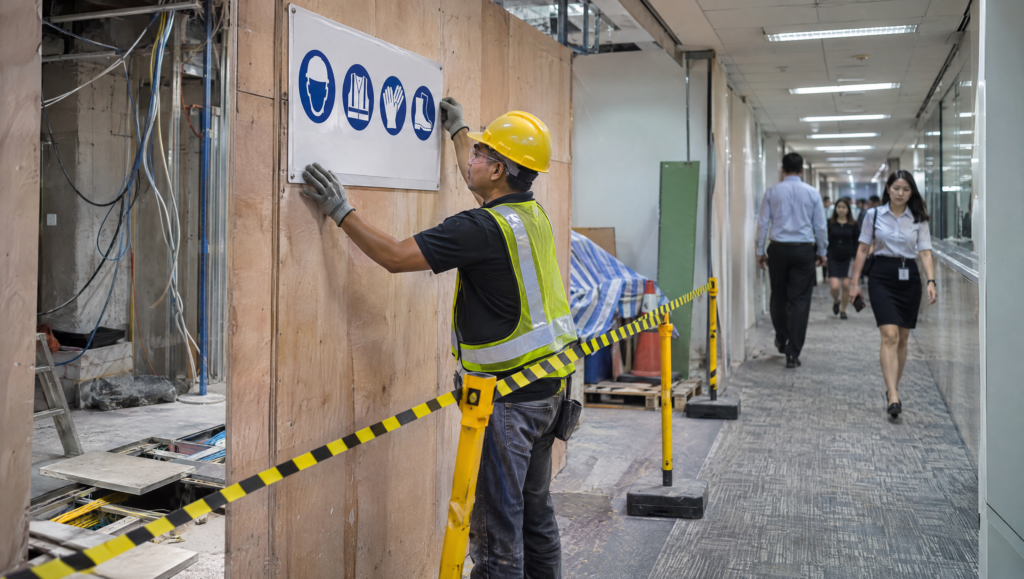
That “what’s actually visible” test is where a small job’s safety posture tends to break down first, because signage is one of the easiest things to treat as optional when a job only runs two or three weeks. A compliant renovation or A&A site needs hoarding signage identifying the contractor, the permit and an emergency contact — visible to the building’s own tenants and the public, not just the crew. It needs hazard warning signage at every live electrical point, open floor penetration, and temporary platform edge, since these jobs create and remove such hazards daily rather than once at setup. It needs mandatory PPE signage at the work-area boundary even when that boundary is a taped-off corner of an occupied office floor, and pedestrian-segregation signage wherever the work area borders a corridor, lobby or shopfront still open to the public — a control greenfield sites rarely need but renovation sites almost always do. None of this is expensive relative to the job value or the fines now in force; it’s simply easy to assume a short job doesn’t need it, which is exactly the assumption MOM’s own numbers say keeps proving wrong.
A Smaller Job Isn’t a Smaller Risk
Construction’s headline numbers are moving in the right direction, and the large contractors driving that improvement deserve credit for it. But a safety record built on the big, well-resourced sites papers over where seven in ten serious injuries are actually happening. For any contractor, building owner or facilities manager running A&A or renovation work — especially work that falls under the thresholds that trigger mandatory safety systems — the practical response to MOM’s review is to stop treating signage and hazard communication as something only “real” construction projects need. Browse our full range of SS 508-compliant construction safety signage and workplace safety signs at safetysigns.sg.
Author: safetysigns.sg Team
Date: 19 November 2026