WORKPLACE SAFETY
Singapore just posted its lowest workplace fatality rate on record — and immediately launched a campaign telling workers the next gap isn’t inspections, it’s the small decisions no one audits. But asking someone to “pause and check” only works if there’s something clear to check against.
A Record Low, and a New Kind of Campaign
In May 2026, the Workplace Safety and Health (WSH) Council did something slightly unusual: it launched a national campaign off the back of good news. Singapore’s workplace fatal injury rate had fallen to 0.96 per 100,000 workers in 2025 — a record low, and within reach of the WSH 2028 target of staying under 1.0. Rather than easing off, the Council used the moment to shift the entire conversation. The new campaign, “I Choose Safety. Together We Care.,” launched at the Woodlands Integrated Transport Hub with Minister of State for Manpower Dinesh Vasu Dash as guest of honour, replaces the three-year “Reporting Saves Lives” campaign that preceded it. The pivot in emphasis is the story: from reporting hazards after the fact, to choosing safety before anything happens at all.
From Compliance to Choice
The operating phrase of the campaign is “Pause. Check. Make It Safe.” It asks every worker, supervisor, and employer to treat safety as a series of small, repeated choices rather than a box ticked once during an audit. The WSH Council’s own framing is explicit: progress this far has come from compliance and reporting, but the next improvement has to come from culture — from the moment someone is about to do something slightly unsafe and decides not to. SNEF has echoed the same message to employers directly, urging them to look out for their people rather than treat safety as paperwork.
The Gap Between a Slogan and a Hazard
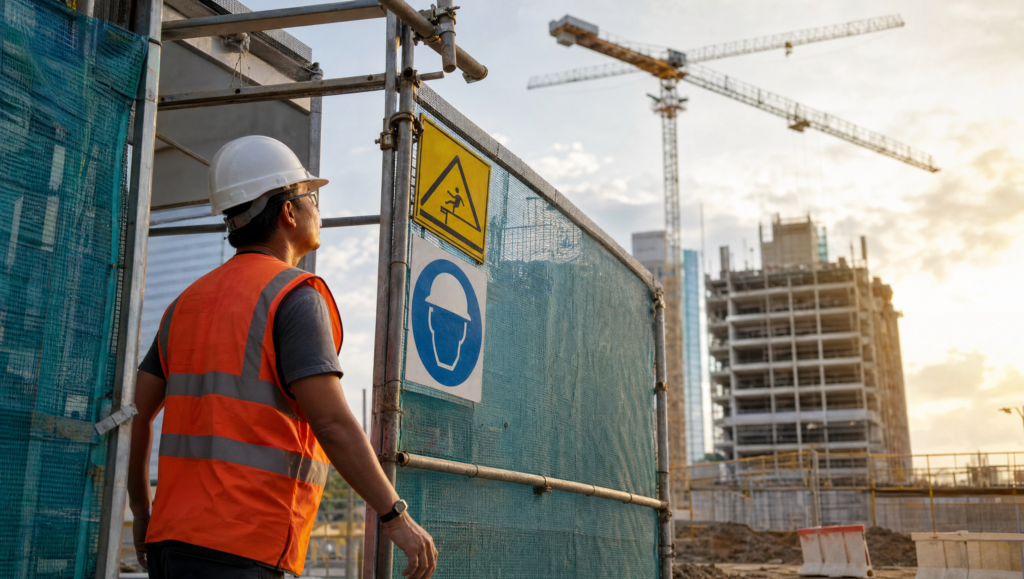
Here’s the practical problem with “pause and check”: pausing only works if there’s something obvious to check against. A worker told to assess a hazard on the fly, with no clear signage marking the boundary of a fall zone, no visible reminder of required PPE, no barrier-mounted warning where a trench or an open edge begins, isn’t being asked to make a safety choice — they’re being asked to spot a hazard that nobody has flagged. Singapore’s own enforcement history backs this up: officials have repeatedly pointed to unbarricaded open edges, missing guard-rails, and unclear access points as the recurring, basic failures behind serious incidents, not exotic or unpredictable ones. A culture of “pause and check” is only as strong as the physical cues that make pausing possible in the first place.
What “Pause. Check. Make It Safe.” Looks Like on a Real Worksite
Translated into practice, the campaign is really asking for three things to be visible at the point of decision: what the hazard is, what’s required before proceeding, and where the safe path actually is. That’s a mandatory sign at a PPE checkpoint, a warning sign at a fall-risk edge, a prohibition sign at a restricted zone, and floor or barrier signage marking out a danger area clearly enough that “checking” takes seconds, not a judgment call. None of this is new SS 508 or ISO 7010 territory — it’s the existing standard, applied with enough coverage that a worker’s pause actually has something concrete to land on.
Why Employers Shouldn’t Wait for the Next Inspection
The record-low fatality rate is genuinely good news, and the WSH Council is right that the next gains will come from culture rather than new rules. But culture change campaigns succeed or fail on the ground, not in a press release — and the ground-level version of “Pause. Check. Make It Safe.” is a signage audit, not a slogan on a poster. Employers who treat this campaign as a cue to walk their own site and check whether every hazard a worker might need to “pause” at is actually marked are the ones who’ll turn the national push into fewer real incidents, rather than a well-meaning message with nothing to act on.
Singapore’s safety story in 2026 is shifting from reporting what went wrong to choosing, moment to moment, what goes right — but that choice depends on workers being able to see the hazard in the first place. Before the next toolbox talk, it’s worth checking whether your site’s signage actually supports the pause the campaign is asking for. Browse our full range of SS 508-compliant safety signs at safetysigns.sg.
Author: safetysigns.sg Team
Date: November 4, 2026