WORKPLACE SAFETY
Two workers died after collapsing inside an enclosed passage at Choa Chu Kang Waterworks in May 2024, poisoned by hydrogen sulphide gas that sensors had already flagged above safe limits. Over two years later, the contractor and its confined-space permit manager have finally been charged — and the case exposes exactly where confined-space controls keep failing on Singapore worksites.
Two Years Later, the Charges Finally Landed
On 16 July 2026, the Ministry of Manpower charged Stargroup — the contractor PUB had engaged to clean a water treatment tank — with failing to implement reasonably practicable measures to minimise risk to its workers. Lim Beng Hock, the firm’s authorised manager for confined-space entry permits, was separately charged with failing to exercise due diligence when issuing those permits. Both charges trace back to 23 May 2024, when three workers entered an enclosed passage beneath a tank at Choa Chu Kang Waterworks to close a set of hand valves. All three collapsed. Two died over the following days; the third was treated and discharged.
What the Investigation Found Inside the Tank
MOM’s investigation found the men were exposed to hydrogen sulphide — a gas it describes as able to kill at low concentrations, and one that deadens the sense of smell that would otherwise warn someone away from it. The detail that should unsettle every facilities and WSH manager reading this: sensors at the site had already recorded levels above safe thresholds, and an alarm had sounded before the men went in. The hazard wasn’t unknown or undetected. It was detected, flagged, and entered anyway. PUB itself was separately fined the maximum S$5,000 under the Workplace Safety and Health Act over earlier, unrelated cases of workers entering its confined spaces briefly without adequate ventilation — suggesting this wasn’t a one-off lapse so much as a pattern of permit discipline breaking down at the point of entry.
The Permit Was the Point of Failure — and the Point of Fix
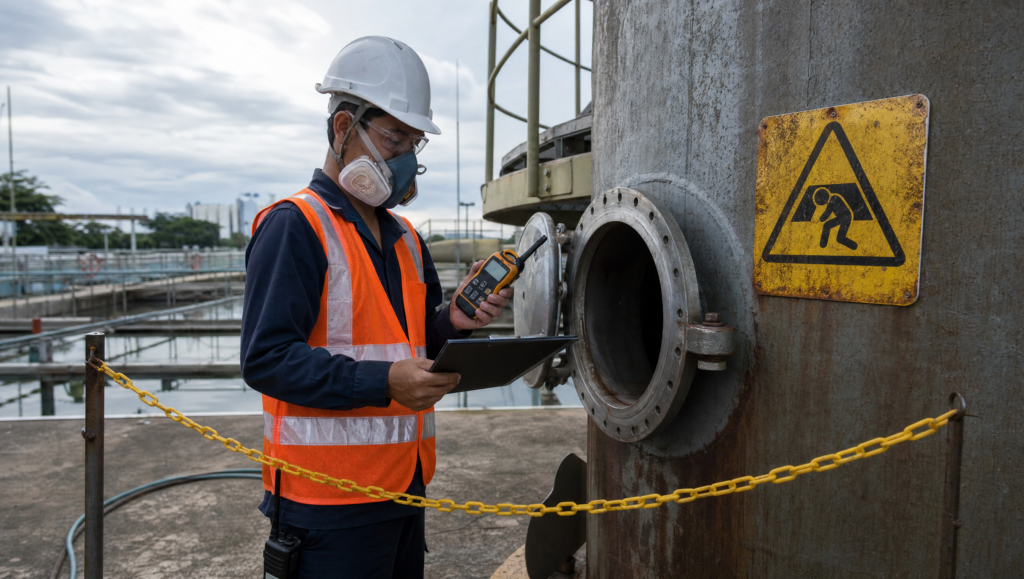
The charge against Lim is the one worth sitting with. A confined-space entry permit exists precisely to force a stop at the hatch: has the space been tested, is it still safe, is a standby person actually posted outside, has every box been checked today rather than assumed from last week. MOM’s charge alleges that stop didn’t function as designed. Whatever the eventual verdict, the agency has already been explicit about what it expects at every confined-space entry point going forward: a documented risk assessment, atmospheric testing immediately before entry (not just at shift start), properly fitted PPE matched to the hazard, and a trained standby worker stationed outside the space for as long as anyone is inside it.
Where Signage Fits Into a Permit-to-Work System
None of those controls work if they live only in a binder in the site office. A permit-to-work system is only as strong as what’s physically posted at the hatch: a clearly visible confined-space warning sign identifying the hazard class, a posted “Authorised Entry Only” notice naming who may enter, and a gas-testing status board that shows, at a glance, whether atmospheric readings are current — not whether they were taken at some point this week. On a site with rotating crews and subcontracted labour, a worker who has never read the risk assessment will still see the sign at the hatch. That is the entire point of having one there. Our hazard warning signs and workplace safety signage are built to SS 508 specifications precisely so that the warning at the point of risk matches what regulators now expect to see when they ask the same question MOM’s investigators asked here: who was supposed to stop this, and what told them to?
What MOM’s 1H2026 Numbers Say About the Climate Around This
This prosecution isn’t landing in a quiet year. MOM’s 1H2026 WSH report recorded 21 workplace fatalities, and the annualised fatal injury rate rose to 1.1, up from 0.97 in 1H2025. MOM has already run two nationwide voluntary Safety Time-Outs this year — in January and again in October — after separate clusters of deaths, and enforcement has tightened alongside them: first-time composition fines are up from S$2,000 to S$3,000, and stop-work orders now run at least eight weeks. Confined-space work hasn’t driven the headline fatality count the way vehicle incidents have, but the Choa Chu Kang charges land squarely inside that broader climate of MOM treating paper compliance and physical, on-site compliance as two different things — and increasingly prosecuting the gap between them.
A risk assessment that correctly names a confined space as hazardous is worth nothing to the next worker who opens that hatch if the warning isn’t there to see. Browse our full range of SS 508-compliant safety signs at safetysigns.sg.
Author: safetysigns.sg Team
Date: 12 November 2026