WORKPLACE SAFETY
MOM’s latest numbers show that 53% of Singapore’s fatal and major workplace injuries last year happened at bizSAFE-certified firms. The certificate on the wall was never the thing keeping anyone safe — what’s actually posted on the floor is.
The Number MOM Published, Then Immediately Cautioned Against
In a written parliamentary answer last month, MOM disclosed that of the 696 fatal and major injury cases recorded in 2025, 53% involved bizSAFE-certified firms — 30% from bizSAFE STAR, 18% from Level 3, and 5% from Level 4 — against 47% from firms with no certification at all. MOM was quick to flag the caveat: the figures are shares of total cases, not injury rates per firm, and higher bizSAFE tiers skew toward higher-risk sectors like construction, so the comparison “should be interpreted with caution.” Fair enough. But the headline a business owner takes away doesn’t need statistical rigour to sting: being certified did not put these firms in the safe half of the ledger.
What the Certificate Actually Measures
MOM’s own framing is the more useful detail here, buried a few lines further down: bizSAFE certification assesses a company’s risk management knowledge, and MOM has acknowledged that certification alone does not yet lead to better safety outcomes. That’s a significant admission from the agency that runs the programme. A risk assessment, a bizSAFE workshop certificate, and a Level 3 or Level 4 audit all test whether a company can produce the right paperwork and demonstrate the right process on the day an assessor visits. None of it tests what a worker on the floor actually sees, hears, or understands at 3pm on an ordinary Thursday, six months after the audit, when the assessor is gone and the site supervisor has rotated off the job.
The Gap Between a Risk Assessment and a Worksite
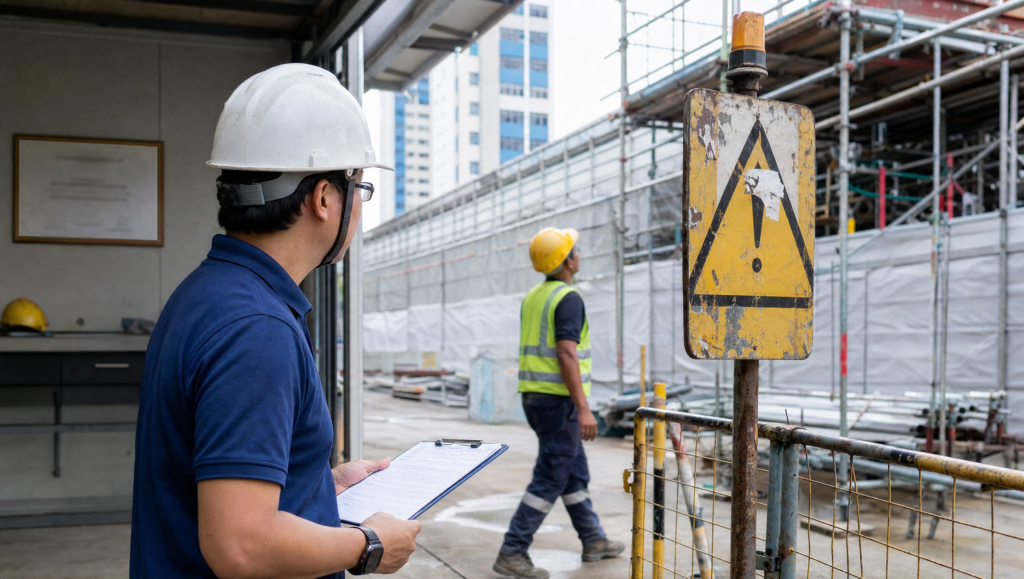
This is where paper compliance and physical compliance quietly part ways. A risk assessment document can correctly identify a fall hazard, a confined space, or a chemical store and still sit in a binder in the site office while the actual hazard zone has a faded, wrong-language, or missing sign. MOM and the WSH Council are now reviewing the bizSAFE programme specifically to link certification more closely to real WSH performance rather than documented intent, which is a tacit admission that the two have been allowed to drift apart. Signage sits exactly at that join: it’s the one control that has to be physically present, legible, and current at the point of risk, every day, regardless of whether an auditor or a client is walking the site that week.
What a Review Like This Usually Means for Buyers and Contractors
When a regulator says a credential is being reinstated to track outcomes rather than paperwork, the practical effect is usually stricter audits and buyers who stop taking a certificate at face value. Main contractors and project owners who currently ask “are you bizSAFE Level 3?” are likely to start asking to actually walk the site, photograph the signage, and check that workplace safety signs and construction safety signage match what the risk assessment says should be there — not just take the certificate on file as proof. Firms that have let their signage lapse since their last audit, or that never matched it to the risk assessment in the first place, are the ones with the most to lose once that scrutiny tightens.
Certification Opens the Door. Daily Conditions Decide What Happens Next
None of this is an argument against bizSAFE — MOM is strengthening it, not scrapping it, and a certified risk management process is still worth having. The argument is narrower: a certificate proves a company once knew what its hazards were and how to manage them on paper. Whether that knowledge is still visible on the ground, at the actual hazard point, for the actual worker walking past it today, is a separate question — and it’s the one MOM’s own numbers suggest too many certified firms are failing. Browse our full range of SS 508-compliant safety signs at safetysigns.sg.
Author: safetysigns.sg Team
Date: 11 November 2026