REGULATION UPDATE
From early 2027, every forklift operator in Singapore will need to pass a refresher course every three years, or stop driving. It’s a direct response to the single biggest killer on local worksites. But a trained operator in an unmarked warehouse is still only half the fix.
The Rule Behind the Headlines
The Ministry of Manpower has confirmed that, under Section 31(4) of the Workplace Safety and Health Act, all forklift operators will be required to attend an enhanced refresher course at least once every three years. The enhanced course itself launched in 2025, but MOM has given the industry until early 2027 before the refresher becomes mandatory, giving employers and principals time to cycle every operator through it. A dedicated WSH circular will set out the compliance details, but the direction is already clear: holding a forklift licence will no longer be enough on its own.
Why MOM Drew the Line at Forklifts
The numbers explain the urgency. Between 2022 and 2023, vehicular incidents were the leading cause of workplace fatalities in Singapore, and roughly one in four of those vehicular deaths involved a forklift. When MOM’s inspectors went looking for the cause, they found it: close to eight in ten of the forklift-related contraventions they uncovered involved operators who had gone more than three years without refresher training. That statistic, more than any single accident, is what turned a guideline into a legal requirement. It also arrives against a wider backdrop of pressure — work-related traffic fatalities in the first half of 2026 already exceeded the whole of 2025, prompting MOM to stand up a new Platform Worker Safety Workgroup and push employers to tighten vehicular safety controls across the board.
Training Fixes the Operator. Signage Fixes the Floor.
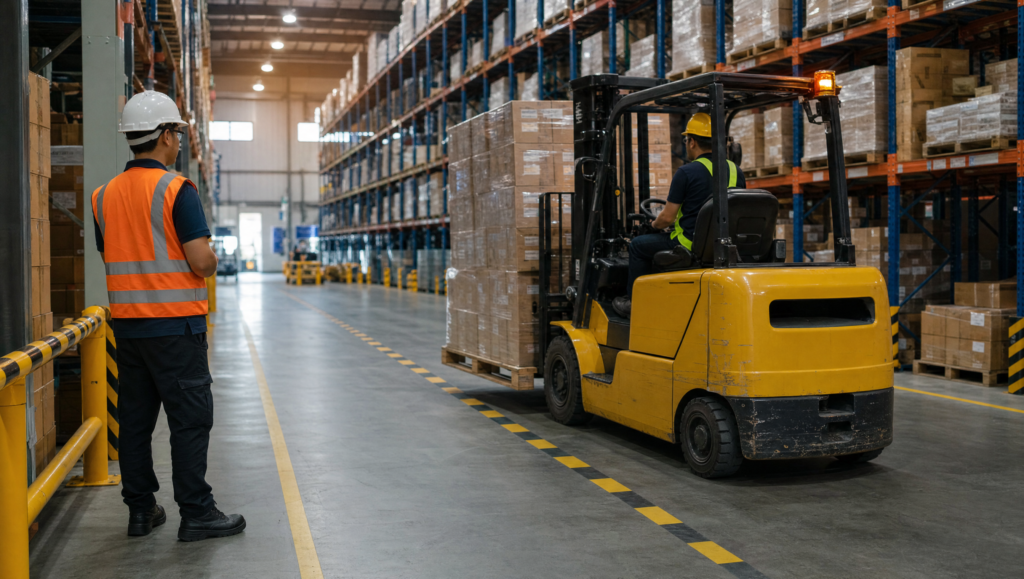
Here’s the gap the headlines tend to skip over: a refresher course changes what an operator knows, not what a pedestrian, a visiting contractor, or a new picker sees when they step into the aisle. MOM’s own guidelines on the safe operation of forklift trucks have long paired operator competency with physical controls — segregated pedestrian routes, marked exclusion zones, and clear signage at blind corners and loading bays. A warehouse that invests in the training but leaves its floor unmarked is still exposed, because most forklift-pedestrian incidents happen exactly where the two paths cross without a visible boundary. Signage is what makes a rule enforceable at a glance, for the operator and everyone walking the same floor.
What a Compliant Warehouse Floor Actually Looks Like
In practice, this means a few specific things should be in place well before an auditor or MOM inspector asks for them. Forklift operating zones need SS 508 and ISO 7010 compliant prohibition signage marking where pedestrians must not enter, paired with mandatory signs at the zone’s edge instructing drivers and walkers alike on right of way. Blind corners and loading bay junctions need warning signage positioned at eye level and vehicle-height, not just floor paint, because paint fades and gets scuffed long before a laminated or rigid sign does. Charging bays, ramps, and racking aisles each carry their own risk profile and should be covered under a site’s broader workplace safety signage plan, reviewed alongside the refresher training schedule rather than as an afterthought once training is booked. Where forklift routes cross construction or renovation zones, the same logic extends to construction safety signage at the interface between the two work areas.
The Window to Act Is Now, Not 2027
Early 2027 sounds distant, but MOM has made clear the grace period exists to let operators get trained, not to let signage audits slide. Warehouse and logistics operators who treat this as a single compliance deadline — book the course, tick the box — will have missed the point MOM’s own inspection data makes plainly: untrained operators and unmarked floors tend to be the same sites. The ones that review both together now will walk into 2027 already compliant, and with a safer floor in the meantime.
Browse our full range of SS 508-compliant safety signs at safetysigns.sg.
Author: safetysigns.sg Team
Date: November 8, 2026