WORKPLACE SAFETY
Singapore’s worksites have never recorded fewer major injuries. The Ministry of Manpower’s first-half 2026 report puts the major injury rate at an all-time low outside of the pandemic. But fatalities are moving the opposite way, and the single biggest reason has little to do with falls, machinery or fire – it’s the moving vehicle.
A Record Low With a Dangerous Exception
MOM’s 1H2026 Workplace Safety and Health report, released this year, shows the annualised major injury rate (excluding platform workers) fell to 14.6 per 100,000 workers, down from 15.8 in the first half of 2025 – the lowest figure on record aside from the COVID-disrupted year of 2020. Construction, long Singapore’s highest-risk sector, posted its own best showing since 2020, with its combined fatal and major injury rate dropping from 27.6 to 24.1. On paper, the system built around bizSAFE audits, risk assessments and the “Reporting Saves Lives” campaign that ran through 2025 is working. Yet the same report shows the annualised fatal injury rate climbing to 1.1 per 100,000, up from 0.97 a year earlier, with 21 workplace deaths recorded in the half. Singapore is getting better at preventing injuries and worse, for now, at preventing deaths – a split that should worry any employer who treats “safety performance” as a single number.
Nine Deaths, One Common Thread
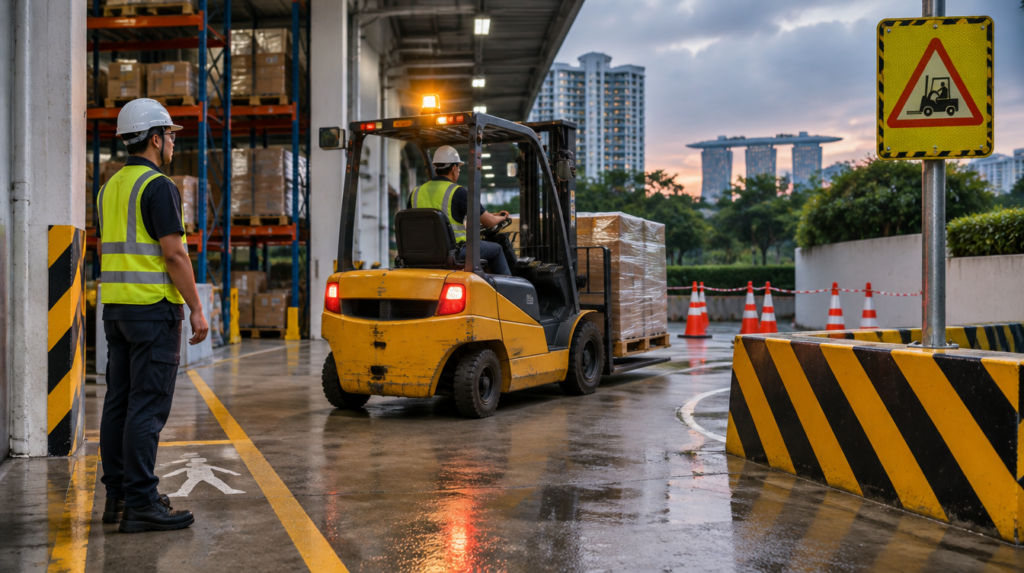
Dig into the cause codes and the pattern is hard to miss: vehicular incidents accounted for nine of the 21 fatalities in 1H2026, making them the single largest cause of workplace death – ahead of falls from height, machinery entanglement and every other category MOM tracks. This isn’t a construction-site story alone. It cuts across logistics yards, warehouses, loading bays and roadside work zones, anywhere forklifts, lorries, cranes or reversing vehicles share space with people on foot. It was also this cluster of incidents – seven worker deaths inside four weeks in late May and June – that pushed MOM to introduce enhanced penalties and a two-week nationwide voluntary Safety Time-Out, a pause the Ministry credits with helping blunt the fatality rise in the months that followed. The uncomfortable implication for site operators is that a worksite can pass every housekeeping and PPE audit and still be one blind reversing manoeuvre away from a fatality.
Platform Workers Face the Sharpest End of the Risk
The vehicle problem is even starker for Singapore’s delivery and ride-hailing workforce. Platform workers recorded a fatal and major injury rate of 92.1 per 100,000 in 1H2026 – improved slightly from 95.9 the year before, but still many multiples of the rate for the workforce at large. Vehicular incidents caused 38 of their 44 fatal and major injuries. MOM formed a dedicated Platform Worker Safety Workgroup in March 2026 to study training standards, safer riding and driving practices, in-vehicle safety technology and better data collection, with findings due by the end of this year. For any business whose premises see constant platform-worker traffic – loading docks, F&B back entrances, retail delivery bays – that workgroup’s eventual recommendations will land directly on the signage and traffic management already in place, or conspicuously missing, at the point where riders and pedestrians meet.
What “Pause. Check. Make It Safe.” Looks Like on the Ground
In May, the Workplace Safety and Health Council retired its three-year “Reporting Saves Lives” push in favour of a new campaign, “I Choose Safety. Together We Care.”, built around a simple instruction: Pause. Check. Make it Safe. The idea is that any worker, at any level, stops and corrects a hazard the moment they see one, rather than reporting it after the fact. It’s a sound principle, but it depends entirely on workers being able to see the hazard in the first place – and a reversing forklift with no warning sign, a blind loading-bay corner with no mirror or marking, or a site entrance where pedestrian and vehicle paths are never visually separated gives nobody the chance to pause before it’s too late. MOM’s own enforcement response leans the same way: inspectors are maintaining higher visit frequency in Metalworking for machinery safety and slip-and-fall risks, and reviewing accountability measures for the smaller renovation and addition-and-alteration jobs that made up 70% of construction’s fatal and major injuries this half – sites that are often too small to have a dedicated safety officer, let alone a traffic management plan.
Where Signage Fits Into the Fix
None of this means signage alone closes a nine-death gap. But it is one of the few controls that scales to every site size, costs little relative to the risk it addresses, and does its job the instant it’s installed – unlike training, which takes weeks to roll out, or enforcement, which only arrives after something has already gone wrong. A visible Give Way or Stop sign at a yard junction, a clearly marked pedestrian crossing through a loading area, cones and barriers defining a vehicle exclusion zone, and mandatory signage at blind corners all give workers the split-second of warning that “Pause. Check. Make it Safe.” assumes they’ll have. For the renovation and A&A contractors now under closer MOM scrutiny, and for any warehouse or yard that routes platform-worker traffic through shared space with staff, a review of the full range of workplace safety signs and construction and traffic safety signage, focused specifically on vehicle-pedestrian conflict points, is a cheap, fast way to act on what the data is actually saying this year.
Singapore’s 1H2026 numbers tell a story with two halves: real progress on the injuries safety programmes are built to catch, and a widening gap around the one hazard – the moving vehicle – that most site signage was never designed around in the first place. Closing that gap starts with looking at every point on a site where people and vehicles cross paths and asking whether a sign, barrier or marking is actually there. Browse our full range of SS 508-compliant safety signs at safetysigns.sg.
Author: safetysigns.sg Team
Date: November 7, 2026